Photograph · real location
Investing in the first Eden Habitat.
Livingstone, Zambia is the selected first-location model: one hypothetical 20-suite Habitat, a seven-night package, three illustrative five-year scenarios and the gates that would have to be passed before any of it is committed.
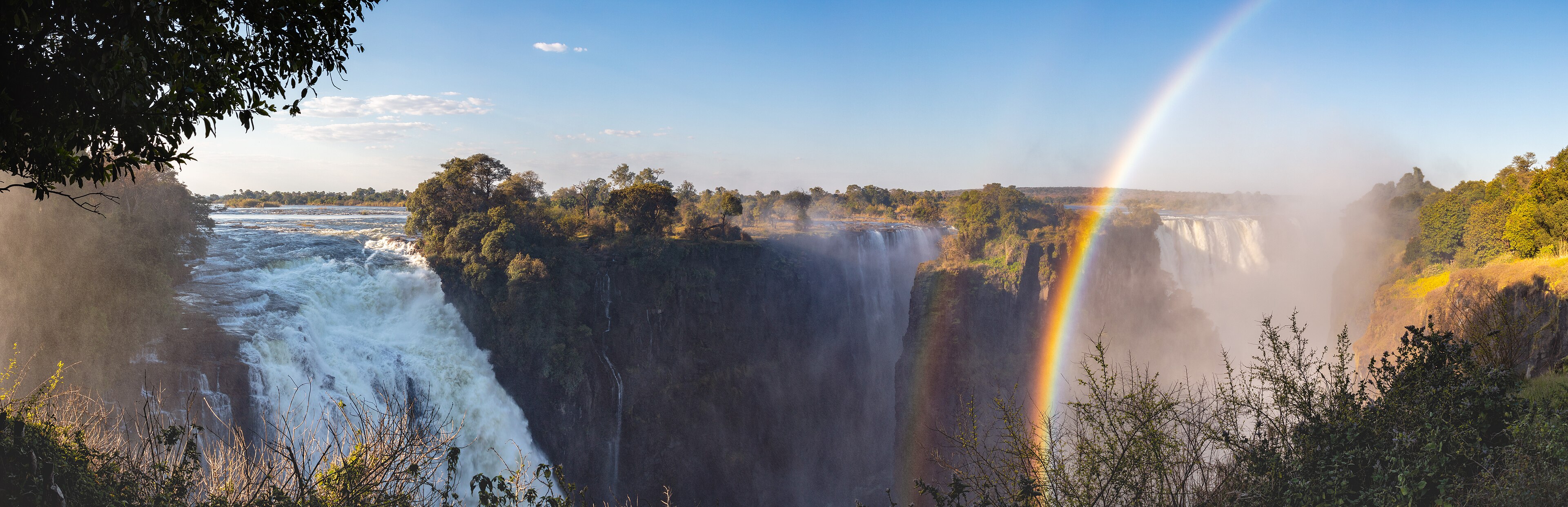
Victoria Falls (Mosi-oa-Tunya) and the Zambezi gorge, on the Zambia–Zimbabwe border at Livingstone — Diego Delso, CC BY-SA 4.0, via Wikimedia Commons. Cropped for layout; contrast overlay applied.
135
paid suite-weeks to cash breakeven
16.875% of 800 annual suite-week capacity, rounded up from 134.45 continuous suite-weeks (16.81%). One suite-week is one suite for seven nights for two guests — not one whole-camp calendar week.
(€444,066 fixed site + central + €100,000 mission floor) ÷ €4,046.63 cash contribution = 134.45 → 135
Net package €6,500 less 12% sales costs, €1,153.37 delivery, 3% replacement and 5% initial working capital. At 134 suite-weeks cash is −€1,818; at 135 it is +€2,229. There is no land rent in the fixed cost base: land use is assumed to be authorised under a government partnership. Tax is zero at this threshold because EBITDA is below depreciation, so taxable profit is negative. It is not zero at the 320-suite-week forecast.
- Operating cash turns positive
- Operating month 5
- Startup spend recovered
- Operating month 53
- Base funding exceeded
- Operating month 58
Project month 23 · €61,089 cumulative free cash generated. The first individual monthly surplus is operating month 3, at +€65,519 for that month alone.
Project month 71 · total capital and pre-opening spend of €3.820m, about six years after development starts.
Project month 76 · €4.620m comparison. This is not an investor payout or IRR.
The line is monthly operating free cash generated after handover, excluding the €800,000 opening reserve. It first turns positive at operating month 5 / project month 23 (€61k), crosses total startup spend at operating month 53 / project month 71, and crosses base funding at operating month 58 / project month 76. It does not reach the stress-covered envelope by project month 78.
Cash breakeven includes delivery, sales fees, fixed site and central expenses, the mission floor, replacement capital, initial Year 1 working capital and modelled tax. It excludes recovery of startup capital, shown separately above. Later-year thresholds differ. All figures are planning assumptions and every milestone depends on demand, costs, schedule and on securing a land partnership that carries no rent.
Premium hospitality pays for regeneration and community work — if one Habitat can first be sold, staffed and run.
The first-location model is a new 20-suite luxury tented and modular encampment at Livingstone & Mosi-oa-Tunya, near Livingstone in Southern Province, Zambia, built on land used under a proposed long-term government partnership rather than a commercial ground lease — no conversion, no refurbishment, no property purchase and no land rent: 20 suites, 40 planned bookable weeks, 800 available suite-weeks, two guests per suite and a seven-night package, delivered through an 18-month development programme. Net package prices compound 6% annually; local Kwacha costs inflate 6% and international euro costs 3%. Euros are the reporting currency, with local costs converted at dated Bank of Zambia midpoints and imported items costed in dollars. Committed funding is €4,619,551 in the base case, or €5,829,551 including the €1,210,000 of liquidity indicated by the severe stresses.
Current status: research stage. Livingstone has been selected as the first-location model, but no parcel, land-use agreement, acreage, build permit, environmental approval, operator, partnership, community agreement or paid guest has been confirmed there or anywhere. All fourteen locations remain research candidates. Forty planned bookable weeks — none in January or February, four in each month from March to December — is a chosen planning schedule. It is not an official tourism season, not verified all-weather demand and not a confirmed opening calendar.
- First-location model
- New build under a proposed government land partnership — 20 suites, 40 planned weeks, Livingstone, Zambia
- Initial funding
- €4,619,551 — €3,819,551 of capital and pre-opening use plus €800,000 opening cash
- Year 1 package (net operating revenue)
- €6,500 per suite-week, two guests sharing, plus applicable taxes
- Mission budget
- Greater of 8% of revenue or a €100,000 Year 1 floor, rising 3%
- All figures are planning assumptions, not achieved returns, confirmed fundraising terms or proof of demand.
- Revision 7 builds a new 20-suite luxury tented and modular encampment under a proposed long-term government land partnership. It excludes land lease expenses entirely: no annual land rent, no development-period land rent and no refundable land deposit.
- That land position is an intention, not an entitlement. No land-use agreement, acreage, duration, grant, title, concession, tax exemption, statutory reserve designation or guaranteed rent waiver is secured.
- Livingstone, Zambia is the selected first location model. No parcel, land-use agreement, build permit, environmental approval, operator, partner, community agreement or paid guest is confirmed there or anywhere.
- Every Kwacha and dollar allowance — wages, construction, tents, plant, pre-opening — is an unquoted management estimate. This is a feasibility budget, not supplier quotations and not quantity-surveyor certification.
- Exchange rates are derived Bank of Zambia midpoints dated 7 September 2026 and are not guaranteed transaction rates. They are held constant in the base case, remain editable and are stress-tested.
- Prices are net operating revenue per suite-week. VAT and tourism levies charged separately are pass-through and are not revenue. The 30% corporate tax line is a transparent planning proxy, not a certified tax computation.
- Asset lives assume a land-use agreement long enough to support them — the proposed land-use term must cover the modelled asset lives, and its duration is negotiated, not agreed.
- The fourteen locations are research candidates, not operating or contracted assets. Only Livingstone carries the Kwacha local-cost preset; it is not applied to other regions.
- No equity percentage, valuation, IRR, payback guarantee, committed facility, management credential or investment term is offered here.
- Environmental regeneration and community upliftment carry equal weight throughout.
Long-term land stewardship instead of a ground lease
Our legacy is the land we help restore and protect, and the communities that thrive alongside it.
Eden seeks a long-term government land-use agreement rather than a commercial ground lease. Public authorities would authorise use of a defined area; in return Eden commits hospitality-funded ecological regeneration, measurable community benefit and enduring protection of that land. Revision 7 therefore carries no land rent and no land deposit anywhere in the model.
- What Eden asks for
- Authorised long-term use of a defined area, measured and reported in acres, with the ecological and community obligations written into the agreement rather than left to goodwill.
- What Eden commits
- Hospitality-funded restoration, a dependable annual mission budget, paid local work and procurement, independent reporting, and continuing care obligations that survive our exit.
- Who would be party to it
- The relevant public authorities together with local communities and customary rights holders as applicable. Consent, fair compensation, cultural and intellectual property protection and reserved decisions are preconditions, not add-ons.
- What the agreement must define
- The area in acres, duration and renewal, the ecological baseline and targets, community governance, independent reporting, how continuing care is funded, our obligations, and what happens to the land and the assets if we leave.
- Collective legacy
- Protected acreage held as shared stewardship. It confers no ownership, tenure, equity or land interest on any guest, member or Guardian.
- Unique mapped acres under signed protection commitments.
- Acres actively under restoration work in the reporting period.
- Condition and outcome measures — reported separately, never merged into an acreage headline.
This is the intended negotiated arrangement, not a secured grant, title, concession, tax exemption, statutory reserve designation or guaranteed rent waiver. No acreage, duration, signed partner or legal term is claimed or invented here. Any additional negotiated protection or community deliverables need site-specific costing before an agreement is signed; the mission budget is a planning floor, not proof that any given acreage can be protected.
Excluding land rent does not make land free. Legal and land due diligence, community consultation, ecological and hydrological baseline work, design, permits, insurance, ordinary taxes, staff and site care, restoration capital and the continuing-care floor are all retained in full, and no replacement fee, subsidy, in-kind land asset or extra revenue is recorded anywhere.
Those references establish that Zambia works through conservation partnerships. They are context only: neither is an offer of rent-free land to Eden, and no application, concession or agreement exists. Zambia Ministry of Tourism — partnership and conservation context · Department of National Parks and Wildlife — mandate
One place, one week, one price.
The initial offer is deliberately narrow: one location, one seven-night programme, defined arrival dates, clear accommodation standards, explicit inclusions and a credible local mission. The first customers are adult couples and pairs of friends who already spend on premium nature or wellness travel and want a purposeful, social week. Solo, family and corporate weeks are separate products to be tested later against the same finite inventory.
Environmental regeneration and community upliftment carry equal weight. Guest contribution of 8–12 supervised hours is explained before purchase, voluntary in practice and additive to paid professional and local work.
A staged path to launch.
- Stage 1Months 0–2
Define and validate
The founder and a hospitality operator turn the concept into one saleable itinerary and a fully priced customer offer. Interview 25–30 relevant travellers, approach 8–10 specialist advisers, compare ten substitutable alternatives, and identify three candidate areas near Livingstone where a government land partnership could realistically be discussed. A local partner assesses whether the proposed guest contribution is useful. Interest forms are learning, not revenue.
Decision gateOne saleable itinerary, a priced offer, three shortlisted candidate areas and honest reservation terms.
- Stage 2Months 2–5
Paid trial cohorts
Two seven-night cohorts in a contracted third-party venue, selling 8–10 suites each, while our own encampment is still on paper. At €6,500 net per suite, eight sold suites represent €52,000 of trial revenue before costs. Gross validation spending cap is €40,000, already inside pre-opening expenses. Trial revenue is deliberately not credited to the five-year funding case.
Decision gateAt least 70% paid occupancy of released trial inventory, achieved net prices at 95% or more of target, positive contribution after venue hire and all direct delivery and acquisition costs, at least 80% of responding guests rating 4/5 or higher, and written partner confirmation that contribution activities are useful.
- Stage 3Months 3–6
Land partnership, diligence and investment decision
Operator, local partners, a quantity surveyor and Zambian professional advisers establish the real build cost, the terms of a government land-use agreement and its duration and renewal, ZEMA environmental screening and permitting, a feasible roster with employer obligations, restoration baseline and mission budget, operating permissions, indirect-tax treatment, insurance and a costed decommissioning and handover plan. Written quotations and a tendered build price replace every Kwacha allowance, and customs charges replace the landed import estimate.
Decision gateA tendered build price within the funded capital envelope, a signed-form land-use agreement long enough to support the asset lives and carrying the ecological, community and reporting obligations, and cash break-even after central support, mission spend and replacement provision at no more than 60% mature occupancy — or an explicitly chosen and funded subsidy model. If any land payment, fee or levy turns out to be required, it is costed and the model is rerun before commitment. Uncontracted grants and investor interest do not count as cash.
- Stage 418-month development programme
Build, commissioning and pre-sales
Design, ecology and the land agreement in months 1–3; site works and procurement in months 4–6; utilities and build in months 7–12; fit-out in months 13–15; commissioning, recruitment, training and a full operational rehearsal in months 16–18. Funding is drawn against the development schedule, with no land rent or deposit in any month. Recruitment, training and launch sit inside pre-opening expenses, separate from operating payroll.
Decision gateAt least 60 paid suite-week reservations across the first 12 open weeks — 25% of that 240 suite-week inventory — at the target net price, and cash at handover of at least the €800,000 opening reserve. An early signal only; refundable deposits remain liabilities.
- Stage 5Year 1 after handover
First operating year and control
Weekly service and booking reviews, monthly cash reviews against the monthly model, quarterly local-partner meetings and a rolling 13-week cash forecast on actual payment dates — including real tax and levy due dates rather than the model's even monthly timing. Acres under protection commitments, acres actively restored and condition measures are reported separately from the start.
Decision gateIf rolling 90-day booked revenue falls below 80% of plan, reassess pricing, acquisition, scheduling and discretionary spend. Freeze capital commitments as cash approaches the €300,000 retained floor. Never cut essential stewardship first; if the floor would be breached within six months without committed funding, run the agreed contraction, handover or closure plan.
Three planning cases on identical capacity.
All three cases hold 20 suites and 40 open weeks — 800 available suite-weeks — for all five years. No expansion, membership or secondary revenue is included. Year 5 contains four 6% increases from Year 1, a total of 26.25%.
Conservative. The lower-demand case. The label is retained for continuity; it is not validated conservative underwriting. Year 1 revenue €2,080k at 40% occupancy; Year 5 revenue €4,267k at 65%. Five-year cumulative operating cash €5,103,993; cumulative mission spend €1,273,792. Workbook sheet: Five Year.
| Measure | Year 1 | Year 2 | Year 3 | Year 4 | Year 5 |
|---|---|---|---|---|---|
| Paid occupancy | 40% | 48% | 55% | 60% | 65% |
| Net suite-week package | €6,500 | €6,890 | €7,303 | €7,742 | €8,206 |
| Sold suite-weeks | 320 | 384 | 440 | 480 | 520 |
| Revenue | €2,080k | €2,646k | €3,213k | €3,716k | €4,267k |
| Mission spend | €166k | €212k | €257k | €297k | €341k |
| Operating profit / EBITDA | €851k | €1,188k | €1,528k | €1,829k | €2,162k |
| Net profit after depreciation and tax | €384k | €610k | €836k | €1,032k | €1,248k |
| Planning-proxy tax at 30% | €165k | €262k | €358k | €442k | €535k |
| Cash after tax, replacements and working capital | €520k | €819k | €1,045k | €1,250k | €1,471k |
| Closing cash | €1,320k | €2,138k | €3,183k | €4,433k | €5,904k |
Charts restate the table above; every plotted value appears there as text.
Where the money goes, before anything is quoted.
| Year 1 cost | Reference allowance | Basis |
|---|---|---|
| Local payroll allowance | €242,020 | ZMW 5,400,000 including employer obligations, benefits, training and relief cover. Gross roster ZMW 3,648,000 plus a ZMW 1,752,000 allowance — not a statutory rate and not market-validated pay |
| Land rent — none | €0 | Government partnership assumption: nil. Revision 7 excludes land lease expenses, so the ZMW 600,000 annual land-rent allowance carried in Revision 6 is removed. Shown as a labelled zero for transparency, not hidden elsewhere, and not a secured rent waiver |
| Utilities, backup fuel, water and waste | €53,782 | ZMW 1,200,000, including generator fuel and water and waste handling |
| Insurance, licensing and administration | €31,373 | ZMW 700,000 |
| Repairs, grounds, security supplies | €26,891 | ZMW 600,000 |
| Local fixed subtotal | €354,066 | ZMW 7,900,000 at 22.3122 ZMW per EUR |
| International marketing | €30,000 | Euro spend, separate from sales commissions |
| Fixed site cost | €384,066 | Local fixed plus international marketing |
| Central support | €60,000 | Lean single-Habitat allowance, in euros |
| Site plus central | €444,066 | Local lines inflate 6% annually, euro lines 3% |
Delivery per occupied suite-week
€1,153
- Local food (ZMW 5,000)
- €224
- Local transfers, laundry and supplies (ZMW 2,500)
- €112
- Flexible local experience labour (ZMW 1,500)
- €67
- International facilitator
- €650
- Imported guest consumables
- €100
ZMW 9,000 of local cost plus €750 of international cost. Middle-case delivery is 2% higher and fixed costs 5% higher; high performance 5% and 10% higher. Local Kwacha lines inflate 6% annually, euro lines 3%.
Mission budget
€166,400
Conservative Year 1
- Professional stewardship
- 40%
- Materials and maintenance
- 25%
- Locally agreed projects and skills
- 25%
- Monitoring
- 10%
Greater of 8% of net stay revenue or a €100,000 Year 1 floor, rising 3% annually, and additional to ordinary payroll and local procurement. A provisional allocation to agree locally, not promised outcomes. €100,000 is reserved inside the cash floor for closure and continuing care.
Development uses and funding
- Base capital expenditure: local construction plus landed imports
- €2,695,775
- Procurement and construction escalation at 5%
- €134,789
- Construction contingency at 25%, assumed fully spent
- €707,641
- Total funded capital
- €3,538,204
- Pre-opening expenses, local: ZMW 3,000,000
- €134,456
- Land rent across the 18-month development period — none (government partnership assumption)
- €0
- Pre-opening expenses, international: €100,000
- €100,000
- Pre-opening expense contingency at 20%
- €46,891
- Total pre-opening expenses
- €281,347
- Refundable land deposit — none (government partnership assumption)
- €0
- Total pre-opening use of funds
- €3,819,551
- Opening cash reserve
- €800,000
- Committed funding, base case
- €4,619,551
- Additional committed liquidity indicated by the severe stresses
- €1,210,000
- Stress-covered committed funding
- €5,829,551
- A new-build luxury tented and modular encampment under a proposed long-term government land partnership. No lodge conversion, no refurbishment of an existing building and no land or property purchase is modelled anywhere.
- Revision 7 excludes land lease expenses: the annual land rent, the development-period land rent and the refundable land deposit are all zero, shown as labelled nil lines rather than folded into another cost. Nothing replaces them — no rent-substitute fee, subsidy or in-kind land value is recorded.
- Local construction of ZMW 40,000,000 covers platforms, bathrooms, pavilions, staff buildings, site works, utilities, restoration landscape and capitalised professional fees. Every line is an unquoted management allowance pending quantity surveying and tender.
- The USD 1,050,000 of imported tents, frames and specialist plant is a landed allowance including freight, duty and non-recoverable charges, cross-converted through the Kwacha pair. Local lines carry installation, so there is no double count.
- Escalation of 5% and a 25% construction contingency are added on top of base capital and are assumed fully spent — appropriate for a first-of-its-kind build in a remote location.
- Pre-opening expenses cover trials, legal and land due diligence, community consultation, recruitment, launch and training, plus a 20% expense contingency. They are separate from the capitalised design line.
- No grant, membership, licensing, debt, land concession value or terminal value funding is assumed, and no raise is secured.
Fourteen research candidates, fourteen planning schedules — Livingstone selected first.
These are chosen planning capacities and schedules, not approved development sizes, permits, measured demand or weather forecasts. Four weeks per month is a conservative scheduling allowance; closed weeks cover maintenance and programme pauses as well as climate and access. Short shoulder months carry 85% relative occupancy weight, normalised so annual occupancy and revenue still reconcile. Professional care continues during guest closures. No restoration area, protected-area lodging permission or community agreement is implied.
| Region | Suites | Open weeks | Suite-weeks | Jan | Feb | Mar | Apr | May | Jun | Jul | Aug | Sep | Oct | Nov | Dec |
|---|---|---|---|---|---|---|---|---|---|---|---|---|---|---|---|
| Algarve / Ria FormosaCulatra & Ria Formosa · research candidate | 20 | 40 | 800 | — | 4 | 4 | 4 | 4 | 4 | 4 | 4 | 4 | 4 | 4 | — |
| Cabo de Gata coastCabo de Gata–Níjar · research candidate | 20 | 40 | 800 | — | 4 | 4 | 4 | 4 | 4 | 4 | 4 | 4 | 4 | 4 | — |
| Granada / Los Velez interiorAltiplano de Granada & Los Vélez · research candidate | 16 | 32 | 512 | 2 | 3 | 4 | 4 | 4 | 2 | — | — | 4 | 4 | 3 | 2 |
| Val Susa / Alpine foothillsMompantero & Bussoleno · research candidate | 16 | 26 | 416 | — | — | — | 2 | 4 | 4 | 4 | 4 | 4 | 4 | — | — |
| Livingstone / ZambiaLivingstone & Mosi-oa-Tunya · research candidate | 20 | 40 | 800 | — | — | 4 | 4 | 4 | 4 | 4 | 4 | 4 | 4 | 4 | 4 |
| NamibiaNamibRand & adjoining rangelands · research candidate | 16 | 36 | 576 | — | — | 4 | 4 | 4 | 4 | 4 | 4 | 4 | 4 | 4 | — |
| Pardamat / MaraPardamat Conservation Area · research candidate | 20 | 40 | 800 | 4 | 4 | 4 | 2 | 2 | 4 | 4 | 4 | 4 | 4 | — | 4 |
| BaviaanskloofBaviaanskloof · research candidate | 20 | 40 | 800 | 4 | 4 | 4 | 4 | 3 | 1 | 1 | 3 | 4 | 4 | 4 | 4 |
| Wadi RumWadi Rum & Rum village · research candidate | 16 | 32 | 512 | 3 | 3 | 4 | 4 | 2 | — | — | — | 4 | 4 | 4 | 4 |
| Jabal AkhdarAl ‘Ayn, Al ‘Aqr & Ash Sharayjah · research candidate | 20 | 44 | 880 | 2 | 2 | 4 | 4 | 4 | 4 | 4 | 4 | 4 | 4 | 4 | 4 |
| DaintreeLower Daintree River · research candidate | 16 | 32 | 512 | — | — | 2 | 4 | 4 | 4 | 4 | 4 | 4 | 4 | 2 | — |
| Kangaroo IslandWestern River & De Mole catchments · research candidate | 20 | 40 | 800 | 4 | 4 | 4 | 4 | 3 | 1 | 1 | 3 | 4 | 4 | 4 | 4 |
| Xingu / QuerenciaXingu headwaters around Querência · research candidate | 12 | 28 | 336 | — | — | — | 4 | 4 | 4 | 4 | 4 | 4 | 4 | — | — |
| TambopataTambopata–La Pampa landscape · research candidate | 12 | 28 | 336 | — | — | — | 2 | 4 | 4 | 4 | 4 | 4 | 4 | 2 | — |
The parts that are not yet settled.
Governance
- Operating structure
- One operating entity for planning, with separately tracked hospitality, mission and central-support accounts. Company form and any charitable or community entity are decided only once jurisdiction, investors and partners are known.
- Capital
- Modelled as equity or patient mission capital with no debt and no interest. No investor distributions are assumed, and any future payout policy must protect the operating reserve and mission commitments.
- Land partnership
- A long-term government land-use agreement in place of a commercial ground lease: the state authorises use of a defined area, and Eden funds regeneration, community benefit and enduring protection from hospitality revenue. The agreement must define the area in acres, duration and renewal, the ecological baseline and targets, community governance, independent reporting, how continuing care is funded, our obligations and what happens on exit. Nothing is granted or signed, and no acreage or duration is claimed.
- Community rights
- A written local partnership precedes any marketing of a Habitat mission: consent, land access, paid work, procurement, intellectual and cultural rights, decision authority, dispute resolution and duties that continue after guests leave. Customary rights holders are party to the land arrangement where applicable. Community ownership is not claimed unless real equity or ownership rights are agreed.
- Local advisory group
- Compensated participation, with proposed reserved decisions over restoration priorities, guest access to sensitive places, cultural representation and use of mission funds, including a veto over work on sensitive land. Directors remain accountable for solvency and legal obligations; advisory powers must be written into agreements.
- Mission funding
- The greater of a €100,000 Year 1 floor, rising 3% annually, or 8% of stay revenue — €166,400 in conservative Year 1, and €1.274m cumulatively across five years. It is additional to ordinary payroll and local procurement, reported separately, with €100,000 reserved inside the cash floor for closure and continuing care. It is a planning floor, not evidence that any given acreage can be protected.
- Reporting on land
- Unique mapped acres under signed protection commitments, acres actively under restoration, and ecological condition and outcome measures are each reported separately. No single acreage headline stands in for outcomes, and protected acreage confers no ownership or land interest on guests or Guardians.
- Labour guardrail
- Guest contribution is additive and supervised. It never replaces paid local labour, public services, professional expertise or local leadership.
Principal risks
- The land partnership is not secured
- The whole Revision 7 cost structure assumes a long-term government land-use agreement with no rent and no deposit. No agreement, application, acreage, duration or public commitment exists. If land turns out to carry rent, a fee, a levy or a bond, the fixed cost base and the funding requirement both rise and the model must be rerun before any commitment.
- Demand is unproven
- No paid stay has been confirmed for this planning case. Willingness to pay €6,500 net per suite-week, and to join a 16-guest week at 40% occupancy, is a hypothesis until trial cohorts sell.
- This is a construction project
- Revision 7 builds a new encampment. Construction risk — tender price, ground conditions, weather, imported delivery, commissioning — sits with us, and an 18-month programme means eighteen months of spending before the first euro of revenue.
- Construction cost is unquoted
- ZMW 40,000,000 of local works and USD 1,050,000 of landed tents, frames and plant are management allowances. There is no tender, no quantity-surveyor certification and no customs ruling. A 5% escalation and a 25% contingency are carried, and a 20% overrun already breaches the cash floor.
- Programme delay
- A six-month delay costs six extra months of skeleton payroll, security and site care at ZMW 250,000 a month plus €10,000 a month of international cost, adds 3% capital escalation and defers opening revenue. Cash at handover falls to €587,855, and combined with the other stresses the model goes to −€900,757.
- Tenure and asset lives
- Twenty-, fifteen-, ten-, seven- and five-year asset lives assume a land-use agreement long enough to support them — the proposed term must cover the modelled asset lives, and its duration is negotiated, not agreed. No parcel, land agreement, build permit or ZEMA approval exists. Assets built on land held under a public agreement may not be recoverable when it ends.
- Obligations attached to protected land
- A partnership that authorises land use in return for regeneration and community benefit creates enforceable duties: monitoring, reporting, restoration and continuing care that outlast a weak season. Any additional negotiated protection or community deliverables require site-specific costing. The mission budget is a planning floor, not proof that a given acreage can be protected.
- Season and schedule
- Forty planned bookable weeks with January and February closed is a planning choice. It is not verified all-weather demand, and Zambezi flow, heat and rainfall could reduce saleable weeks.
- Price escalation
- 6% annual package growth against 6% local and 3% international cost inflation is the requested planning input and a material source of projected margin. It is not evidence of pricing power.
- Local operating costs are unquoted
- Payroll, utilities, insurance and repairs are all management allowances. None is a supplier quotation or market-validated wage.
- Currency
- The dated Bank of Zambia midpoints are derived, not guaranteed transaction rates, and are held constant in the base case. A 20% stronger Kwacha alone lifts local construction and operating costs and cuts the opening reserve to €297,136 — a floor breach on its own.
- Imported equipment and customs
- The USD 1,050,000 landed allowance covers freight, duty and non-recoverable charges without a supplier or customs quotation. Tent fabric on a five-year life is the shortest asset and the largest reinvestment exposure. Import timing and clearance risk are not modelled.
- Tax and levies
- Corporate tax is a 30% proxy on positive accounting profit after depreciation, with no loss carry-forward or incentives assumed. VAT at 16% and the 1.5% tourism levy on qualifying components are treated as pass-through; qualification, base, capex VAT recovery and local capital allowances all need adviser validation. No tax exemption follows from a land partnership. Uniform monthly tax in the cash model is planning timing, not the statutory payment calendar.
- Four stresses do not pass
- The stronger Kwacha, the 20% overrun, the combined stress and the combined stress with a delay all breach the €300,000 cash floor, the worst by €1,200,757. About €1,210,000 of additional committed liquidity would be required, taking the prudential envelope to €5,829,551. No facility is secured.
- Community agreement
- No consent, partnership or restoration access is agreed anywhere. Free, prior and informed consent, local ownership, cultural and intellectual property protection, fair compensation and community veto remain preconditions.
Open diligence
- Paid bookings at the actual tax-inclusive package price, in peak and shoulder periods.
- A signed-form government land-use agreement: defined area in acres, duration and renewal, ecological baseline and targets, community governance, independent reporting, continuing-care funding, our obligations and what happens on exit.
- Written legal advice on whether any land payment, fee, levy or bond applies, and on the security of assets built under a public land agreement.
- A tendered build price and quantity-surveyor cost plan replacing the ZMW 40,000,000 construction allowance.
- Supplier quotations and a landed-cost calculation, with customs treatment, for the USD 1,050,000 of imported tents, frames and plant.
- ZEMA environmental screening and approval, plus build and operating permits.
- An operator-approved staffing roster with Zambian employer charges, leave and cover.
- Zambian adviser confirmation of corporate tax, VAT recovery, capital allowances and tourism-levy qualification.
- Restoration baseline, monitoring design and a costed decommissioning, exit and continuing-care plan.
- Site-specific costing of every protection and community deliverable the agreement would require.
- Insurance covering construction and operations, and confirmed land-use rights.
- Written local partnership terms, including reserved decisions and grievance remedy.
Replication conditions
- Verified positive cash generation at the first Habitat.
- Maintained mission funding through a full season.
- Acceptable service outcomes and partner-confirmed local benefit.
- Sufficient reserves after the first site's obligations.
- A new site-specific budget with local quotations — the Zambia cost preset is not transferable.
What would count as this working.
Year 1 tests whether the 20-suite Habitat can sell 320 suite-weeks — 640 guest stays — at the target price, on about €520k forecast operating cash (the €519,721 conservative Year 1 free cash after tax, replacement and working capital) and €166k of mission spend. Across five years the conservative reference supports 4,288 expected guest stays and €1,273,792 of mission spending. These are activity and funding estimates, not proof of ecological recovery or community outcomes, and no probability of success is assigned.
| Dimension | Evidence required | Decision rule |
|---|---|---|
| Guest value | Achieved rates, completed stays, complaints, refunds, reviews and repeat or referral purchases | Meet price and service targets without persistent heavy discounting |
| Financial sustainability | Positive cash after fair staffing, central support, mission, tax, replacement and working capital | At least 12 months of positive cash generation before considering replication |
| Local benefit | Paid employment, local procurement, partner-approved programme and recorded grievances | Partners confirm benefits and unresolved concerns have an agreed remedy |
| Ecological improvement | Baseline and repeat measurements appropriate to the site | Independent specialist confirms progress against locally defined 1-, 3- and 5-year targets |
| Continuing care | Funded maintenance, documented access and a viable exit or handover plan | Stewardship can continue through a weak season or closure |
The full narrative, chapter by chapter.
Every word of the Revision 7 document is below, rendered from the same file offered as a download so the two cannot diverge. Open a chapter to read it; the print action expands all of them.
Revision 7 · Business plan, launch plan and Zambia-first financial model · New-build luxury tented and modular encampment under a proposed government land partnership · No land lease expense · 40 planned bookable weeks · EUR reporting
All figures are planning assumptions for a New Earth Initiative. This is an unquoted feasibility budget, not a set of supplier quotations and not quantity-surveyor certification. Nothing here is a promised margin, an achieved return, a confirmed fundraising term or proof of demand. No equity percentage, valuation, IRR, payback guarantee, committed facility, management credential, partnership or investment term is offered or implied. The fourteen locations are research candidates, not operating or contracted assets. No parcel, land-use agreement, acreage, build permit, environmental approval, operator, partner, community agreement or paid guest is confirmed in Zambia or anywhere else.
Take the whole plan with you.
- Business, launch and financial plan (Markdown)
Revision 7: a new-build luxury tented and modular encampment near Livingstone under a proposed long-term government land partnership, with no land rent and no land deposit, on forty planned weeks. The same document that is rendered in full in the chapter reader on this page — headings, tables and citations included.
- Financial model workbook (XLSX)
The actual working model: a first-position Breakeven sheet, dated FX inputs, the Kwacha and dollar construction build with land rent and deposit at a labelled zero, an asset register with per-asset lives, the 18-month development draw schedule, three scenarios, monthly Year 1, seven stress cases, sensitivity, the Europe comparison and sources. Region 5 (Livingstone) is selected; other regions reprice capacity and season only, not local costs.
There is no PDF file. The button below prepares a complete paper copy — every chapter of the narrative expanded and all three scenario tables included, whichever scenario is selected on screen — and then opens your browser's print or "save as PDF" dialogue.
Nothing on this page is an offer of securities, an investment recommendation or a commitment by anyone. No equity, valuation, return, payback or funding term is stated, and no partnership, permission or community agreement has been confirmed for this planning case.